Wednesday, April 28, 2021

St. Helier Tides

 Jersey has a roughly 12 meter tidal range (the difference in "sea level" between the lowest and highest stages of tidal ebb and flood). It's hard to comprehend just what that means, but these pictures may help.

The difference in height between high and low water varies according to the monthly lunar cycle, with the largest difference occurring just after new and full moons (so-called "spring tides"), and the smallest difference occurring around the waxing and waning half-moons ("neap tides"). There are other factors that affect the tidal range, so there is also slight variation among spring tide ranges from month to month.

 We are, as I write this, at the height of this month's spring tide, with the port of St. Helier having an 11.2 meter difference between high and low water. Here in the marina, we are sheltered from the very lowest tide by a "sill", which traps water in the marina as the tide recedes, helping keep the boats behind the sill afloat. So the pictures below don't even reflect the entire tidal range.

This first pair of pictures was taken looking towards Idril, currently docked at the end of the "B" pontoon in St. Helier Marina. Note the large dark piling on the left (with a white cap labeled "B" on its top).

Low water

High water. Yes, Katy has her foot on the top of that same piling.

This next pair shows the "Welcome" sign on the marina seawall at low and high water.


If you look closely at the bottom of that railing, it becomes clear that even a slight storm surge would flood that sidewalk and street at the top of the seawall, to say nothing of what a meter of sea level rise would do.

There is a ramp from the pontoons up to the top of the seawall and the marina office and facilities. The angle of that ramp varies a lot, too. At high water springs, the ramp actually slopes slightly down from the pontoons to the gate.


Finally, remember that sill I mentioned, which we have to sail over to get into the marina? Here's the view from the outside of the marina at low water springs. The water in the marina is protected from going that low by the sill.


There are a few more pictures of the tidal range, including some "high water humor", in this album.


Saturday, April 10, 2021

St. Vincent volcano from space

 Yesterday (Friday, April 9, 2021) the La Soufrière volcano on St. Vincent in the Caribbean erupted explosively.  I went looking for good images on news sites, with little success, so I went to the NOAA satellite imagery site and poked around.

Sure enough - there are images from GOES (the Geostationary Operational Environmental Satellite system). I used their image capture tool to download successive images at 10 minute intervals. You can find them all in this album.


Monday, April 5, 2021

Cherbourg to Jersey

 Katy and I are now in St. Helier Marina on the Channel Island of Jersey. We left Cherbourg a bit after noon on Good Friday and arrived shortly before dusk. We positively flew for most of the trip. We had strong (25-35 knot) east-northeast winds most of the way, we were able to catch a helpful west-going tidal eddy as we passed along the northwest corner of the Cotentin peninsula, and we had tidal currents with us for the remainder of the voyage. Here's our track from Marine Traffic:


We averaged 9.9 knots!

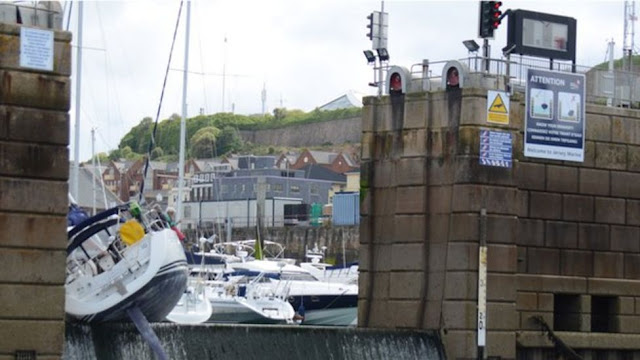
We're settled onto the "hammerhead" end of "B" dock, which gives us a good view of the entrance to the marina. We get to watch a steady stream of boat traffic for entertainment while the marina is open, which is three hours each side of high tide. The entrance to the marina is a "sill", which is just what it sounds like: a wall, or set of low gates, that retain the water in the marina at a sufficient height. That height is low relative to the entire tidal range (which, here in Jersey, is an enormous 12 meters!), so during the period around high tide, boats can float in and out over the sill. In an area with large tide swings, it's an elegant solution to keeping boats afloat during low tide without the need for locks or swinging gates. But you must time your arrival and departure such that your boat (including its keel and rudder...) will clear the sill. Here's what happens if you don't:


Ouch... 


We'll be here for at least two weeks, with the first 11 days spent strictly aboard the boat in quarantine. We had our "day zero" COVID-19 arrival tests (negative - yea!) on Saturday morning, which will be followed by 5- and 10-day tests. Assuming those next two tests are also negative, we'll be released on day 11, and can begin exploring Jersey. And, assuming the rules don't change (a large assumption...), we'll then be able to sail directly from Jersey to the southern coast of the U.K. and not have to quarantine upon arrival. We should also be able to get the first of two vaccination shots before we leave, getting us started on the road towards a little less worry about the coronavirus.

How did we wind up in Jersey? There's a bit of a tale to tell.

Our goal for some time had been to leave Cherbourg by the end of last week (Friday, April 2nd). While we have informal assurance from the Manche prefecture that our residence permits will be renewed for another 3 months, we have nothing official to that effect, so we figured that we had best be gone by midnight on April 2nd to avoid overstaying our current permits.

Our initial plan was to go to Portsmouth or Southampton on the southern coast of England. We would have to quarantine for 10 days after arrival, but we figured we could probably manage to get our GoCycles sent off for some required service during that time, which would be great: we can't ride them while in quarantine. We had a berth reserved in Portsmouth and were settled on that plan, when we discovered, somewhat by accident, that we would not be able to quarantine on the boat, but would have to go to a special quarantine hotel - at 750 GBP per night!

Ouch.

A few frantic phone calls later, we were assured by the harbor master in St. Helier that we could quarantine on the boat, so Jersey it was.

Checking out of Cherbourg was interesting. Before Brexit, there was little point in "officially" clearing out of Cherbourg, since nearly all destinations in easy reach were in the Schengen free-travel zone. Now, though, since we were headed to Jersey, we really needed to formally leave France. But there isn't any obvious place to do that in Cherbourg.

So - we scheduled a visit by the "PAF" (the French border police) for early Friday morning. Two very pleasant and polite officers arrived at the boat at 5:30AM, stamped our passports, and were on their way. We're committed!

As noted above, we left about 12:30PM and had a great sail over.

On Saturday morning, after our day zero tests, we were visited by the Jersey customs officers and had our passports stamped for entry to Jersey. We should be good for 6 months in the Common Travel Area without further visa issues. Yea!

Pictures from the trip here.


Sunday, March 14, 2021

Conservatives?

 Those of you following this blog to read reports of Jerry and Katy sailing aboard Idril can close this tab right now. This has nothing to do with sailing.

I follow (and support on Patreon) a podcast called "Know Your Enemy" by Matthew Sitman and Sam Adler-Bell that (generally) discusses the history, methods and goals of the Conservative movement in America. (I wonder if they would agree with that assessment?)

 The "logo" of the podcast is an iconic (at least to me, a certified Old Farte...) image of William F. Buckley, host of Firing Line and founder of the National Review.


 In the comments section of Patreon, someone recently posed this question:

Who is the dude featured in KYE's thumbnail?

 I was greatly amused, and then more thoughtfully realized that Mr. Buckley is probably completely unknown to the vast majority of current Americans.

So - who might be a conservative whose image would be recognizable to people under 40, and who might be appropriate in the context of Know Your Enemy, which is about much more than just the current batch of Trumpian morons in control of the Republican party?

In that spirit, here are some images for your consideration. Most of them are similar Old Dead White Guys, but a few are of a more recent vintage. Can you name them? Note: One is an Easter Egg, not a Conservative.

Enjoy!


Hint: "In your heart - you KNOW he's right."


Monday, March 8, 2021

It's alive!!!

 "It" being our Iridium GO, a little satellite communication gizmo that we can use to download weather reports and wind maps ("GRIBs") while far offshore (at 2400 baud - really!). We've been trying, without much success, to get it working ever since the boat was launched back in June. It turns out that Garcia used a totally inappropriate kind of coaxial cable (RG-223 instead of LMR-400) between the external antenna (mounted on the arch at the stern of the boat) and the transceiver itself (mounted at the nav station). The result was a nearly complete loss of signal. 

 (Hard-core geeks can take a look at the Times Microwave cable calculator to see why.  The Iridium up/downlink frequencies for "end user" stations are at about 1625 MHz. Pick RG-223 and LMR-400 and look at the cable efficiencies (or, if you are REALLY geeky, at the dB losses.))

I've ordered a length of the correct cable (LMR-400-UF, a more flexible variant of LMR-400) and the necessary connectors (male TNC), and hopefully by the end of this week (or maybe the next...) we will have a working system.

Meanwhile, to test the software setup, I just put the unit itself (which has mediocre built-in antenna) out in the cockpit and connected to it with WiFi from my iPad. Amazingly, it works!

Downloading the GRIB files

And - the graphical wind display!


This is very good news, because it means that even if we have problems with the external antenna, we should be able to get weather information while far offshore (such as when sailing between Europe and the Caribbean).

Further update (March 19, 2021)

The saga of our Iridium GO continued for about another ten days. 

Katy and I carefully measured the actual distance from the antenna to the location we were thinking of using for the GO (above the door to the aft head). When you account for all the snaking around (up and down and through the arch, the aft compartment, up and down bulkheads, etc.), the cable run would have been at least 15 meters. The absolute max length for LMR-400-UF (a very high quality, purpose-appropriate cable) would be 12.8 meters (to keep the loss to no more than 3dB, the value Iridium specifies).

So - we had to find another location. We settled on the bulkhead over the access hatch to the aft watertight compartment. By routing the cable down through the hull in the space just forward of the starboard helm, the cable run could be kept to 10 meters. We discussed this with Vincent Mauger of Grand Large Services, and he concurred that this should work, and would not adversely affect the integrity of the aft watertight compartment. Power for the GO ( all 8 watts...) could be gotten from one of the SFSP Scheiber blocks in the engine compartment.

After several days of diligent work by GLS, it's all working.

Five bars!

 The takeaways from this saga are:

  • The cable loss specification must be respected. Use LMR-400-UF or an equivalent, and keep the cable run as short as possible, and definitely not more than 12 meters.
  • The short adapter cable that patches between the TNC connector on the LMR-400-UF and the crappy little TS-9 connector on the GO is fragile. Our first problem with the GO was a broken adapter cable. The mounting plate that Iridium supplies with the external antenna kit subjects the cable to very small radius bends, and it's easy to pinch the cable under the plate. Hence, we routed the cable entirely outside the plate (see above).
  • Don't discount the possibility that the GO itself has a problem. Our original GO seemed to have a problem using an external antenna at all; perhaps the TS-9 connector failed internally? In any case, Grand Large Services replaced the unit without any questions. Bravo!
  • Even with everything working well, the Iridium service is slow. The claimed data rate is 2400 baud (not very fast), but it's actually much worse than that. Even with 5 bars, the connection is unstable, and the most data I've received in one pop is about 30Kbytes before re-connection (which takes at least 30 seconds) Luckily, the transfer protocol used by PredictWind accommodates restarting, so the data already received is not lost.

Friday, February 5, 2021

Idril returns to the ocean!

 And hopefully we soon will, too.

Idril was hauled out on January 7th and towed to the Garcia yard for almost a month. During that time we have a bunch of projects done - a mix of system upgrades, minor repairs and lifestyle improvements. She was relaunched yesterday (Thursday, February 4th) and today we motored her back to slip Q32 at Port Chantereyne. There is still some work to be completed (most notably, new 24V winch motors to replace the 12V motors), but she's mostly ready for us to resume sailing. Yea!

Idril in the slings, ready to be re-launched

Back in the water!

Here's a list of what we had done; I'll try to elaborate on at least a few of these in subsequent postings. You can see pictures of much of the work in this album.

  • Add a clutch at the mast for the gennaker halyard (replacing the clutch in the cockpit), so one person can deploy and retrieve the gennaker.
  • Use the freed-up clutch in the cockpit for a cunningham for the second reefing point. We use reef two a lot, and there was so much friction in it that we always had to go forward to the mast to rig it. This should allow us to reef from the cockpit.
  • Add permanently-attached preventer lines to the boom. We can now easily rig a jibe preventer without having to lasso the end of the boom.
  • Add a set of inboard jack lines (straps, actually) to the coach roof, to supplement the outboard jack lines. This should make it safer to go forward as far as the mast.
  • Add new tie-down points to the coach roof, to make it easier to stow our tender (the "F-RIB") on passage, when we don't want it hanging from the arch.
  • Install turning blocks on the sides of the cockpit to make it easy to run a line across the cockpit to a free winch.  We've often found ourselves wanting another winch; since there isn't really room for adding winches, this will let us use winches that are otherwise not in use.
  • Fix a few cosmetic dings: chipped or worn paint in the cockpit, and scratches and tears in the nice film wrap on the hull.
  • Insulate the sail locker to reduce condensation, add plywood sheathing to protect the new insulation and provide attachment space for hooks, and put a plastic fender over the exposed aluminium struts, whose sharp edges have cut both us and sail bags.
  • Put a check valve into the sail locker bilge pump outflow hose, to try to keep the bilge in the locker dry.
  • Many changes to the Scheiber system that controls Idril's DC power system:
    • Install a second "Navicolor" display and control panel for the Scheiber DC control system near the companionway. This will make it easier for the person on watch to control the system, and provides redundancy.
    • Add a new "Block 9" power distribution unit under the nav desk, to provide some expansion capacity and accommodate some equipment we installed last summer (the Vesper AIS transceiver and our WiFi repeater).
    • Replace the "Block 8" units that control our fuel and water transfer pumps; they did not have sufficient current-handling capacity.
    • Upgrade the software throughout the Scheiber network to address some intermittent bugs (mostly equipment turning off at random...) and add new capability.
    • install some new network cabling and (frankly) connector hacks to address network connector reliability concerns.
  • Install a recording barometer to give us some improved situational awareness regarding weather.
  • Add some new cabinetry:
    •  A new shelf in the tech room to make it easier and safer to stow tools, spares, etc.
    • A swing-down drawer under the cockpit floor and above the large central storage space, letting us use more of that vertical space.
    • A cabinet in the forward head (which previously had very little usable space for things like toothbrushes and other personal care goodies).
  • Install a built-in soap dispenser at the galley sink.
  • Add lights to the tech room and aft cabin (which were pretty dark without them).
  • Update the software in all of the B&G navigational instruments.
  • Add a chain counter to the windlass so that we can easily see how much anchor rode we have deployed.
  • Hinge the leeboards, making them much easier to stow.
  • Install a USB outlet in the ceiling near the nav station for a clock.
  • Add a coat to the bottom paint (which was in surprisingly good shape, probably due to the SoniHull).
  • Replace the zinc anodes on the propeller and line cutter, clean all the other anodes.
  • Fix the Iridium GO! antenna; one section of the antenna cable was damaged.
  • Change the motors on our large primary winches from 12V to 24V and power them from the forward battery bank (which also powers the windlass, bow thruster and capstan). This project isn't quite finished; Garcia is waiting on parts. This will eliminate a voltage sag on the NMEA2000 network that we experienced when using the winches.
  • Add a circuit breaker for the stove in a convenient location in the galley.
  • Retune the standing rigging, now that we've done enough sailing for the metal lines to have stretched and settled.

I have probably missed a few things, as amazing as that may seem.

 Tonight should be our last night in the Airbnb in Bretteville. It will be nice to be back in our cozy little home.

Saturday, January 16, 2021

Idril is hauled out

We're back in Cherbourg to have the usual post-sea-trial inspection and servicing done, and to have some other changes made to the boat.It turns out that there is enough work to be done that it made sense to have Idril hauled out and schlepped back to the Allures/Garcia yard in Tourlaville, rather than having technicians bring all their tools and supplies to the marina ever day.

So -- on January 7th, we motored out of the marina and over to the commercial dock, which is about a kilometer from the yard.

The commercial slip is in the lower left corner; the yard is in the upper right.

With Vincent, the Grand Large Yachting service manager, at the helm, Idril was carefully maneuvered into the lift slip.

Approaching the slip. The lift is not yet in place.

Sneaking in over the slings


Once the slings were in place, the lift was carefully engaged, and up she went!


The lift was then ever-so-slowly backed down the slip onto the pavement, where the initial inspection could be done, and the boat then lowered onto a transport cradle.


We were delighted to see that there was essentially no growth on the hull; it seems that the combination of bottom paint and SoniHull has been very effective. There were some barnacles on the propeller and shaft, so we are planning to have a SoniShaft installed to help with that.

If you look very carefully at the picture above, you'll notice that the very end of our centerboard is nice, shiny aluminium. That's where a bit of the (very soft) bottom paint was scrapped off when we crossed a very shallow, but luckily sandy, shoal in the Isles of Scilly. I had a feeling we might have cut that a little too close...

And here she is, dried out in her cradle at the yard. 


We're not sure how long all the work will take, but it will be at least another week. Here's a partial list of what's being done:

  • new cabinet for the forward head
  • shelf in the workroom
  • drop-down storage drawer in the workroom
  • additional lighting in the workroom and aft cabin
  • replacement of the 12 volt winches with 24 volt winches (to solve a voltage droop on the house batteries when we run the winches)
  • additional tied-down points on the coach roof for the FRIB (while on passage) and centerline jack line
  • insulation of the sail locker, and plywood panels to allow us to attach hooks to hold things in place
  • add a clutch to the mast for the gennaker halyard, so that it no longer runs back to the cockpit, making it easier for one person to hoist the gennaker
  • addition of a separate aft line for reef point 2, to make it easier to reef entirely from the cockpit
  • addition of a second Scheiber control panel near the companionway, to make it easier to get to controls while underway, and to provide redundancy
  • addition of a Scheiber "Bloc 9" power switching block under the nav desk to allow us to add new consumers
  • replacement of several Scheiber  divices that turned out to be undersized for the current demanded
  • replacement of Scheiber network cables with a cables using a more robust connector
  • touch up some chipped/worn paint in the cockpit
  • add some turning blocks in the cockpit to allow lines to easily cross to winches on the far side when necessary
  • retune the standing rigging
  • update all of the onboard electronics to the latest software revisions
  • add padeyes and lines to the boom to allow a preventer to be easily rigged

And there's more. But you get the idea - that's a lot of work. Some of it's already been done as I write this, and it seems that Garcia is doing very nice work. Here is the new cabinet in the forward head. Katy designed it, and it's already been installed in another Exploration 45 that's nearing delivery; the owners saw the drawings Katy did and asked for it.


 Meanwhile, we are living in a nice little Airbnb in Bretteville, a few kilometers east of Cherbourg. It's not as convenient for shopping, but there are nice opportunities for walking and biking nearby. The next few weeks are likely to be pretty quiet for us.

Sunday, December 20, 2020

Catching up on the Solstice

 Tomorrow is the northern hemisphere winter solstice, and that seems like a good time to at least slightly catch up on what Katy, Idril and I have been up to since my  last real blog post back in mid-October.

We left Dartmouth, where we had been pinned down by weather, on October 20th, rounding Portland Bill well to its south, and arrived at Studland Bay around sunset, anchoring just outside of Poole rather than trying to enter a shallow, heavily trafficked and unfamiliar estuary in the dark. 


"Old Harry" and "Old Harry's Wife" rocks, at the south end of Studland Bay

The next morning we motored around the corner to the south side of Brownsea Island and anchored, spending two nights before setting off for the Solent.


Brownsea Island is known as the birthplace of Scouting. Troops
from all over the world visit , often leaving signs.

The Solent is an iconic sailing region on the south coast of England, the starting point of the biennial Fastnet Race, and chock full of harbors and anchorages to explore. It lies between the south coast of England and the Isle of Wight, and our approach from Poole took us past The Needles, a set of rocks defining the western edge of the narrow channel west of the Isle of Wight.


We picked up a mooring in Newtown Creek, on the south side of the Isle of Wight. We stayed for three nights, again waiting out weather, and exploring Newtown and Shalfleet.


From Newtown we sailed back to mainland England and Buckler's Hard, on the Beaulieu River. Buckler's Hard was an important wooden shipyard in the 18th and 19th centuries, and is surrounded by New Forest (new in the 11th century...). I found it to be a wonderful, flattish bicycling territory! :-)


After several more days of waiting out weather at Buckler's Hard, we sailed back across the strait to the Isle of Wight, this time to East Cowes - the actual starting point of the Fastnet race.


Our final port of call in the Solent was Chichester Marina, which is behind a lock a long way up a somewhat scary inlet with large over-falls if you approach at anything other than slack tide. We left East Cowes on the morning of November 3rd and arrived at the marina in the early afternoon - in time to get in a walk into the actual town of Chichester. It was a long walk, and we didn't get back to the marina until well after dark.


Wing-on-wing towards Chichester

The upside of rain showers

The next day we learned that the U.K. was about to re-impose a COVID-19 lockdown. It was hard to get reliable information as to what this meant for us, so we went out on the morning of November 4th for a nice bike ride near the marina.


Upon our return to the marina, we learned that, if we stayed, we would be confined to the boat for the entire lockdown - a real problem, as we were not suitably provisioned. Further, it appeared that the marina lock would be shut down for lockdown that night, leaving us TRAPPED in  Chichester Marina -- and the U.K. -- for at least a month. We really needed to get the boat back to Cherbourg for the post-launch checkout, so on very short notice, we prepped the boat for sea and set off for Cherbourg, regardless of the weather and tide state.
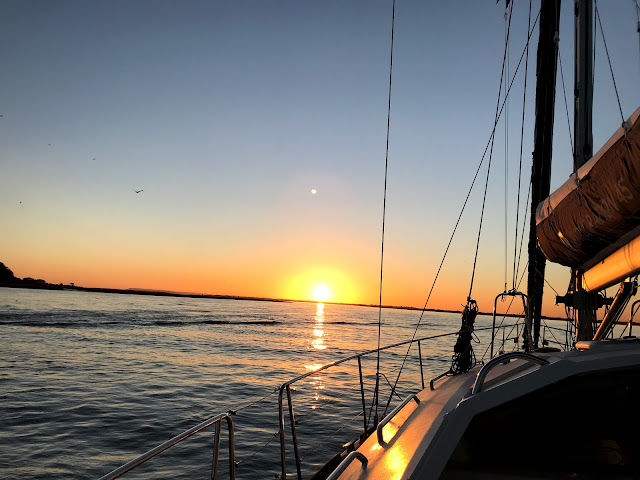
Leaving Chichester at sunset, about to enter the Solent

Luckily, the winds were very mild (we had planned on waiting for stronger northeast winds, expected in a couple of days), so we had a gentle, if slow, sail across the Channel to Cherbourg.

Daybreak over the English Channel

Sailing on just the gennaker

It doesn't get much better...

Almost to Cherbourg

Our AIS was broadcasting our location, and shortly after we entered French waters we were contacted on VHF radio by signal station Barfleur, asking us our destination, and (essentially) "What are you doing entering French waters when France is locked down and not accepting leisure craft?" Luckily, we could (legitimately) explain that we were headed for Cherbourg for repairs and winter service, which are valid reasons for arriving in France.

We've been in Cherbourg ever since.

SO - here we are. We have spent the past 6 weeks or so doing boat maintenance chores, trying to get our long-stay visas extended (they expire on January 1, 2021), and working with Garcia (actually, Grand Large Services) on the issues to be dealt with on the boat. Cherbourg is a very reasonable place for us to be. We know the town well (from our stay here this previous winter and spring), the weather is acceptable (rainy, but not too cold), and the incidence of COVID-19 is (at least for now) low. 

On Monday, January 4th, we will sail the boat to the commercial dock in Tourlaville, and GLS will haul the boat and have it taken to the Garcia yard for the work that must be done. We have reserved a nice Airbnb east of town (in Bretteville) for the 2+ weeks that the boat will be on the hard. It will be weird not living on the boat; since we moved aboard in June, it's really become our home.

Our tentative plans are to spend the winter in France (hopefully further south), then sail to Ireland and Scotland in the spring. At the end of the summer we will head south, reaching the Canary Islands in October or November, to be ready to cross the Atlantic to the Caribbean in December/January -- a year behind our original schedule.

This year has certainly been very different from what we had planned, but I can't say that I'm especially unhappy about it. We have the boat, we've been learning how to live aboard, meeting nice people, and seeing new places. COVID-19 has certainly whacked our plans for a loop - but isn't that true for everyone? We're still healthy, we still have each other and our family and friends, and life goes on.

I wish all of you a Happy Hanukkah, joyous winter solstice, Merry Christmas, and much better 2021.

-- Jerry (and Katy)

More pictures (some duplication from album to album):